
PCOS Root Causes: Insulin, Inflammation, Stress and the Gut
Updated: Aug 29
By Rita Soares, Nutritionist
The root causes of PCOS are metabolic and hormonal, not ovarian. PCOS is not a cyst problem, and the symptoms most women are treated for — irregular cycles, acne, unwanted hair growth, hair thinning, stubborn weight, difficulty conceiving — are downstream of something driving them.
In eleven years of clinical practice, the women who arrive with a PCOS diagnosis have almost always been treated at the level of those symptoms, and almost never at the level of the driver. That gap is what this article is about. In most women the driver is one or more of three things: insulin resistance, chronic low-grade inflammation driven largely by excess body fat, or a stress and adrenal androgen pattern. Nutrition works when it targets the right one. It stalls when it does not.
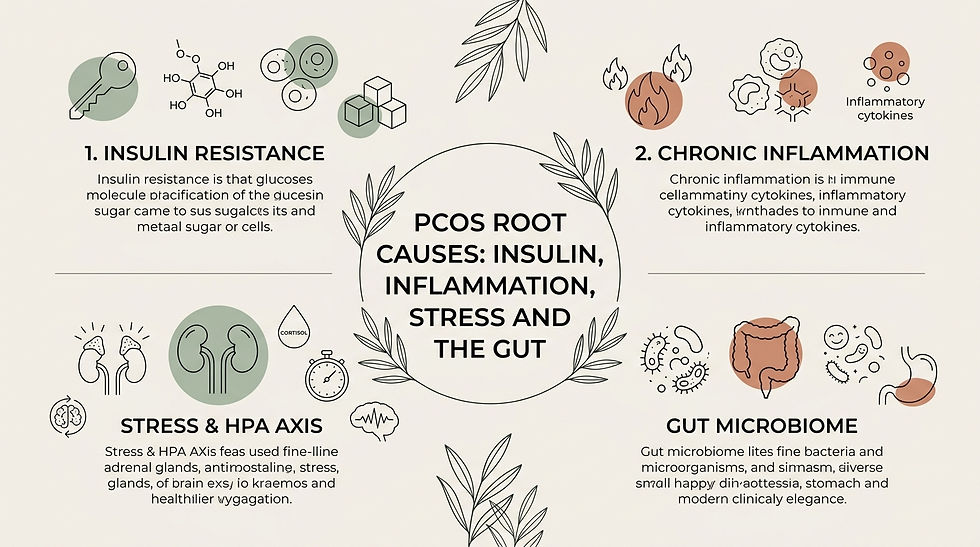
Key takeaways: PCOS affects 10 to 13% of women worldwide and up to 70% are undiagnosed.Insulin resistance is a core mechanism: high insulin raises ovarian testosterone and lowers SHBG.Excess body fat, especially visceral fat, actively produces inflammatory signals that worsen insulin resistance.There is no single PCOS diet. What predicts results is whether the plan targets your specific driver.
What is PCOS?
Polycystic ovary syndrome affects an estimated 10 to 13% of women globally, and up to 70% of them are never diagnosed. It is the most common cause of anovulation worldwide.
The name is misleading. Those "cysts" are not cysts at all. They are immature follicles, eggs that started to develop and then stalled because the hormonal signal to finish the job never arrived. The 2023 International Evidence-based Guideline recognises that PCOS can be present when cycles are irregular and there are signs of high androgens, even where the ovaries look entirely normal.
Clinical note: the name is not a harmless historical quirk. Women are routinely told their ovaries look normal and sent away, when normal-looking ovaries exclude nothing. I have lost count of the number of patients who spent years believing they had been ruled out.
Which brings us to the useful question. Not "do I have PCOS", but "why is my body producing this pattern".
What actually causes PCOS?
No single cause has been established, and any practitioner who tells you otherwise is overselling what the evidence supports. There is a clear genetic component, and women with a family history of PCOS or type 2 diabetes carry higher risk. But genes load the gun, and the environment decides how loudly the syndrome expresses itself.
That is the whole premise of a functional approach. You cannot change the genetics. You can change a large part of what is expressing them, and that is where nutrition does its work: on the drivers, rather than on the surface symptom.
The conventional route is usually medication to regulate bleeds, an androgen blocker for skin and hair, metformin for glucose, and ovulation induction if you want to conceive. These are legitimate tools. But none of them answer why the pattern started, which is why symptoms so often return the moment the medication stops.
What are the main types of PCOS?
The patterns most commonly described in functional medicine are insulin-driven, inflammatory, and adrenal or stress-driven PCOS. Each has a different root cause, a different symptom picture and a different starting point.
A caveat that matters: these are clinical patterns used in functional and integrative practice to guide where to look first. They are not official diagnostic subtypes in the international guideline, and most women are a blend of two rather than a clean single type.
Pattern | What it looks like | What sits underneath it |
Insulin-driven | Energy crashes after meals, sugar cravings, weight that sits around the middle, skin tags, dark velvety patches on the neck | Glycaemic signalling, hyperinsulinaemia, body composition |
Inflammatory | Cystic acne, joint aches, headaches, bloating and unpredictable digestion, excess abdominal fat, fatigue that sleep does not fix | Inflammatory load, gut barrier function, adipose signalling |
Stress and adrenal | Symptoms that flare in high-pressure months, poor sleep, heavy training load, and a picture that does not look insulin-driven | HPA axis activation, cortisol rhythm, energy availability |
Why does insulin resistance matter so much in PCOS?
Because insulin is not only a blood sugar hormone. When it runs persistently high, it acts directly on the theca cells of the ovary and drives testosterone production. Simultaneously it suppresses the liver's output of sex hormone binding globulin, the protein that keeps testosterone bound and inactive in circulation.
Two effects, one cause. More testosterone is made, and a greater proportion of what is made is biologically active. That combination is what shows up on your skin, in your hair, and in the ovulation that keeps not happening.
The international guideline recognises insulin resistance as a core mechanism in PCOS, and this is where body composition genuinely matters. Fat tissue is not inert storage. It is an active endocrine organ, and excess fat, particularly visceral fat around the organs, releases inflammatory signals that worsen insulin resistance directly. More fat means more inflammation, more inflammation means more insulin resistance, more insulin means more androgens, and more androgens push fat storage back toward the abdomen. It is a loop, and it feeds itself.
This is why body composition is one of the more powerful variables in PCOS, and I am not going to pretend otherwise. What is less well understood is that the loop has a direction. Adipose inflammation drives insulin resistance more forcefully than insulin resistance drives fat storage, which means the inflammatory arm is where the system is most sensitive to intervention.
What is frequently missed: this loop is self-reinforcing, which is why sequence is a clinical decision rather than a matter of preference. A system actively generating inflammatory signalling behaves differently from one that is not, and it responds to the same input differently.
The encouraging part is that insulin sensitivity is among the most responsive variables in human physiology. It answers to what you eat, how much muscle you carry, how you sleep and how you move.
Not sure which pattern is yours? In a first consultation we go through your history, your cycle and your symptoms, and map which driver is doing the most damage before changing a single thing on your plate. Book a consultation →
Can you have PCOS if you are not overweight?
Yes, and in my practice she is the patient who has waited longest for an answer. Lean PCOS describes women who meet the criteria for the syndrome at an entirely normal body weight. The assumption that PCOS is a condition of larger bodies is precisely why so many of them are dismissed at the first consultation and never re-examined.
The mechanism is the same one described above, arriving by a different route. Insulin resistance is not exclusive to excess body fat. It can be driven genetically, by chronic stress and disrupted sleep, by prolonged under-eating relative to training load, or by a body that carries relatively little muscle even at a low weight. A woman can be slim and still be producing more insulin than her tissues need.
What complicates the picture is that the standard advice does not apply to her. The most common PCOS recommendation is weight loss, and for a woman who is already lean that is not merely unhelpful. Restriction in a lean, insulin-resistant, often under-recovered body raises the stress burden and tends to worsen the androgen picture rather than improve it.
What drives the lean presentation is rarely excess intake. It is more often low energy availability relative to demand, disrupted sleep architecture, and a stress physiology holding adrenal androgens elevated. These are physiological states, not lifestyle descriptions, and they respond to different levers than the ones she has been handed.
Why are PCOS and gut health connected?
This is where my own clinical focus sits, and it is the part of the picture most consistently absent from a standard PCOS consultation.
The gut microbiome is not a separate system from the hormonal one. Women with PCOS consistently show lower gut microbial diversity than women without it, and the degree of that difference tracks androgen levels rather than body weight. The gut picture correlates with how strongly the syndrome is expressing itself, independently of size.
The mechanism runs through inflammation. When the bacteria that maintain the gut lining decline, the barrier becomes more permeable, and bacterial fragments that should stay inside the gut reach the bloodstream. The immune system responds to those fragments with persistent low-grade inflammation, and that inflammation interferes directly with insulin signalling. From there the cascade is the one described above: more insulin, more ovarian testosterone, less SHBG.
Research published in Nature Medicine took this further. Transferring gut bacteria from women with PCOS into germ-free mice produced a PCOS-like picture in the animals, while bacteria from healthy donors did not. That moves the gut from something merely associated with PCOS to something participating in it.
There is a second thread worth knowing. The bacteria in a healthy gut produce short-chain fatty acids, which regulate the hormones signalling that you have eaten enough. When those bacteria are depleted, appetite regulation is measurably impaired.
Why this matters: the carbohydrate cravings women with PCOS describe are not a discipline problem. They are the predictable output of a disrupted signalling system, and I have watched patients carry years of unnecessary shame over a mechanism nobody had explained to them.
The reason this system is modifiable at all is that it runs on dietary substrate. The bacterial populations maintaining the barrier and producing short-chain fatty acids depend on what reaches the colon undigested, which means dietary pattern acts on the microbiome directly rather than incidentally. It is also why the restrictive approaches most women with PCOS have already attempted tend to work against this arm of the mechanism.
How does nutrition influence PCOS?
Through three mechanisms, and all of them sit upstream of the symptoms rather than alongside them.
The first is insulin signalling. Every meal produces a glycaemic response, and that response determines how much insulin the pancreas releases. Because insulin acts directly on ovarian theca cells and simultaneously suppresses hepatic SHBG production, the pattern of insulin exposure across a day is not a metabolic curiosity. It is one of the most direct influences on how much free testosterone is circulating. Dietary composition alters that exposure, which makes it the shortest route between what happens at the plate and what happens at the ovary.
The second is inflammatory load. Diet modulates systemic inflammation in both directions. An anti-inflammatory dietary pattern reduces the inflammatory signalling that interferes with insulin receptor function, while a pro-inflammatory one sustains it. Since inflammation is the step that converts excess adipose tissue into insulin resistance, this is not a peripheral consideration in PCOS. It is the mechanism itself.
The third is the microbiome. As above, the bacterial populations that maintain the gut barrier and produce short-chain fatty acids depend on substrate that is dietary in origin. This is the arm of the mechanism most people are unaware of, and the one where the gap between what a woman has been told and what her physiology is doing tends to be widest.
Individual nutrients participate throughout all three pathways: in insulin receptor signalling, in the enzymatic reactions of steroid hormone metabolism, in the inflammatory cascade, and in the structural integrity of the intestinal barrier. Insufficiency anywhere in that network constrains how well the system can function, regardless of what else is being addressed.
Clinical note: none of this yields a diet you can look up, and I would treat any source that offers you one with suspicion. The guideline is explicit that no single dietary pattern has proven superior in PCOS. I would put it more strongly: the question is malformed. There is no PCOS diet because there is no single PCOS.
Which mechanism is dominant in a given woman is what determines where the leverage sits, and that is a clinical judgement drawn from a history rather than from a diagnosis. Two women with the same three letters on the same referral letter can need work at opposite ends of this system.
Related reading: the gut microbiome and your health, and nutrition and thyroid function.
One thing worth naming, because it rarely makes it into articles like this: depression and anxiety occur at significantly higher rates in women with PCOS. If that is part of your picture, it is a recognised feature of the condition, not a personal failing, and it deserves support in its own right.
Frequently asked questions
Can nutrition improve PCOS?
Yes, and the mechanisms are well characterised. Nutrition acts on PCOS through three routes: the insulin response to meals, which governs ovarian androgen production and the liver's suppression of SHBG; systemic inflammatory load, which determines how readily insulin resistance develops; and the gut microbiome, whose barrier-maintaining populations depend on dietary substrate. What the research does not support is a single PCOS diet. No dietary pattern has proven superior to another, because which of those three mechanisms dominates differs between women, and that is what determines where the leverage sits.
Can you have PCOS without cysts on your ovaries?
Yes. The current international guideline recognises that PCOS can be present when cycles are irregular and there are signs of high androgens, regardless of how the ovaries look. Many women with PCOS have perfectly normal-looking ovaries, which is one reason the condition is so often missed.
Can you get pregnant with PCOS?
Yes. PCOS is the most common cause of anovulation and a leading cause of infertility, but the majority of women with PCOS do conceive, whether naturally, with lifestyle and nutrition support that restores ovulation, or with medical assistance. The core issue is usually irregular or absent ovulation rather than an inability to get pregnant.
Does PCOS go away?
PCOS does not disappear, because the underlying tendency is largely genetic. But the way it expresses itself is strongly influenced by the drivers underneath it, and those drivers respond to how you eat, move, sleep and recover. That is why the goal is a sustainable pattern rather than a short intervention.
Does body weight affect PCOS?
Where there is excess adipose tissue, yes, and through a specific mechanism rather than a general one. Fat tissue is endocrinologically active: it releases inflammatory signals that impair insulin receptor function, which raises circulating insulin, which drives ovarian androgen production. Visceral fat is the most metabolically active in this respect. That said, lean women develop PCOS and insulin resistance too, which tells you body weight is one variable in the system rather than the system itself.
Is inositol worth taking for PCOS?
The evidence is weaker than the marketing suggests. The systematic review that informed the 2023 guideline concluded that inositol has limited clinical benefit in PCOS and classified it as experimental for fertility. It may still have a place for some women, but it is not a substitute for addressing the driver, and it is worth discussing with your practitioner rather than adding on your own.
Stop guessing which PCOS advice applies to you If you have been diagnosed and handed a prescription with no explanation, or you suspect PCOS and no one has taken you seriously, a consultation is where we identify which driver is doing the most damage, and in what order to address it.
Book your consultation →If you would rather see the structured route first, the Longevity, Hormones & Body Optimization Program is the four-month programme that covers PCOS and hormonal health. If gut symptoms dominate your picture, the Gut Health Reset Program may be the better starting point. Online and in-person appointments available.
Scientific References
Teede HJ, Tay CT, Laven J, et al. (2023). Recommendations from the 2023 International Evidence-based Guideline for the Assessment and Management of Polycystic Ovary Syndrome. European Journal of Endocrinology.
Torres PJ, Siakowska M, Banaszewska B, et al. (2018). Gut microbial diversity in women with polycystic ovary syndrome correlates with hyperandrogenism. Journal of Clinical Endocrinology & Metabolism, 103(4), 1502–1511.
Qi X, Yun C, Sun L, et al. (2019). Gut microbiota–bile acid–interleukin-22 axis orchestrates polycystic ovary syndrome. Nature Medicine, 25(8), 1225–1233.
Tremellen K & Pearce K. (2012). Dysbiosis of Gut Microbiota (DOGMA): a novel theory for the development of polycystic ovarian syndrome. Medical Hypotheses, 79(1), 104–112.
Lindheim L, Bashir M, Münzker J, et al. (2017). Alterations in gut microbiome composition and barrier function are associated with reproductive and metabolic defects in women with PCOS. PLoS One, 12(1), e0168390.
This article is for education and does not replace individual medical advice. If you suspect you have PCOS, or you are already being treated for it, discuss any changes with your doctor or a qualified practitioner who knows your history.


Comments